UNITED CANADA’S SPATIAL REVOLUTION
CARELESS ON THE CANADIAN FRONT

This post was accidentally published out of order. It should appear following the series on Reformers of Upper Canada. There will be a post linking back to it when its proper place does come up in the correct publishing order.
In an earlier post, we noted Donald Creighton’s observation that the rebellions of the two Canada’s in 1837 were the final straw in a long conflict between the commercial and agricultural forces over the future of historical Canada. He certainly observes other factors, including the impact of economic crisis, but the role of that longstanding conflict is a core thread of the story: ‘’In one important sense the rebellions were simply the final expression of the conflict between agrarianism and commercialism, between feudal and frontier agriculture and the commercial state…’’
Following the suppression of the rebellions, Lord Durham was dispatched by the UK government to investigate the circumstances and find a solution. This is a topic we’ll return to in future installments to this new series on United Canada’s spatial revolution. At this point, I only want to follow up on the extent to which that fundamental phenotype wars conflict — between the spatial revolution of commerce and/or empire and the agrarian temporals recalling of the pluralist constitution — continued to play themselves out even after the union of the two Canadas, as recommended by Lord Durham.
The expectation was, on the one hand, that such a legislative union would encourage assimilation by the French into British culture1, and on the other that union would overcome obstacles to western commercial expansion which were widely perceived as resulting from the jurisdictional separation of the two Canadas. Plus, there were other grievances, for instance many in Upper Canada felt that the colony was getting short changed in its proper share of the customs tax collected in the port of Montreal. So there were numerous pressures and logics pushing in the direction of union — an idea, incidentally, that dated back to at least 1822.
Still, there had been sound reason for the division of the original province of Quebec. Once the United Empire Loyalists began moving north, in response to the American war of independence, they found themselves living in a Quebec colony which not only was overwhelmingly populated by those of French descent, but the Quebec Act of 1774 had guaranteed to them the right to maintain their Catholic religion, their seigneurial land tenure system, their civil law, and of course their French language. It hardly made sense that the Loyalists, fleeing the overthrow of the British empire down south would move north to only find themselves living within an even more alien society.2
So, in 1791, it was deemed necessary to divide Quebec into the two colonies that became Lower and Upper Canada. This initiative sheltered the vastly smaller population of Loyalists from Lower Canada’s very different ethnic context. What was missed in this solution was that Montreal, increasingly an English dominated city, housing a powerful merchant class, in its efforts to use public funds to create the infrastructural improvements to communication systems, would be constantly thwarted by a French majority in the elected assembly.
Indeed, during the 1830s, when solutions were being explored, one prospect discussed was the idea that the colonies remain separate, but that Upper Canada would annex Montreal away from Lower Canada. This plan would have freed the Montreal merchants from the political control of the majority French population. However, as we saw in our series on the Upper Canada R/reformers, this would hardly have constituted an end to the Montreal merchants’ battle with agrarian temporals; the Upper Canada farmers too resisted such infrastructure improvements — most famously in the battle over the building of the Welland canal.
As might be expected, then, the merging of the two Canadas into a legislative union did not end the tensions between commerce and agriculture (or spatialism and temporalism). In an essay which provides some insight into these dynamics, by James Careless, not only do we see these tensions continue, decades later, but Careless perhaps more than any of the other scholars we’ve examined accentuates the ventriloquist relationship between the Reformer leaders and the reformer agrarians. Indeed, toward that end Careless emphasizes the importance of this development in eventually ushering in the next and greatest chapter of the spatial revolution on the Canadian front: official Canada’s 1867 Confederation.
However, notwithstanding whatever benefit may have been initially perceived in the uniting of the two Canadas, United Canada turned out to have its own set of chronic problems: e.g., persisting commerce and infrastructure disputes; French resistance to westward expansion, fearing the result being a population boom among non-French Canadians; and the influence of the French Catholics upon school and education policy in Canada West. As a result, by the 1850s, the Canada West agrarian reformers had developed a strong appetite for resolving the ills of United Canada through secession from the union.
In the view of many Canada West reformers, the unseemly imposition of external rule by the British empire had only been replaced by that of Canada East’s French Catholics. As we’ve seen with Romney (see here), indeed, responsible government came to mean for such reformers precisely the end of such infringements upon the colony’s local self-government. In contrast, the professional and commercial urban class that had taken a leadership role in the movement as Reformers, recognizing the longstanding benefits of maintaining the St. Lawrence River drainage basin as a single political and commercial entity, managed to herd the reformer movement into an endorsement of federalism as a solution to those ills.
This was a clear case of the nascent managerial class ventriloquizing the agrarian temporals into a position that not only profited them personally, but more to the point promoted the interests of the empire of the St. Lawrence over the values and communities of the agrarians. Though as we saw with Romney’s analysis, Careless too recognizes that it was the changing social and economic conditions (i.e., the advance of the spatial revolution) which eventually resolved Creighton’s commercial and agricultural conflict, as the farmers became a decreasingly important part of the political landscape with the rise of urbanism and industrialism.
Before, then, moving on to a deeper dive into the emergent conditions of — first historical, then official — Canadian federalism, tracing those roots back to the final chapters of the two Canadas, it seems appropriate to follow through some of the insights from previously discussed scholars, particularly Romney, as many of the same relevant dynamics continued to impact United Canada. Careless addresses those developments in a tidy article, ‘’The Toronto Globe and Agrarian Radicalism, 1850-67.’’3
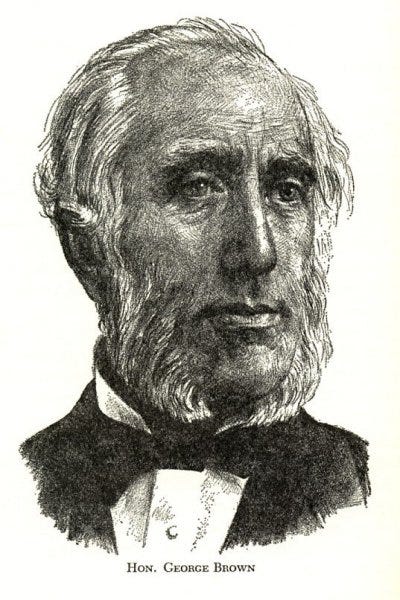
Early in the article, Careless warns against a common tendency in the historiography to regard the Globe — George Brown’s influential newspaper, published from 1844 until 1936, when it merged with the Mail and Empire to form the current Globe and Mail — as simply a mouthpiece for Canada West’s agrarian reformers. Addressing such a view, he says:
…if followed too narrowly [that tendency may] obscure other significant characteristics of the Globe and the movement it represented. The wholly “agrarian approach,” if one may so call it, needs qualification. To explain the complex opinions of the Globe even generally in terms of the outlook and aspirations of pioneer farmers is to overemphasize one aspect of the journal and to neglect or misconceive other aspects of considerable importance. For instance, it would be unwise to assume too much from a premise of agrarianism about the Globe’s attitude toward democracy, or its views on commerce and manufacturing or banking and railways. It would not be sufficient to identify the Globe -- and George Brown himself -- with the aims and interests of a farming population. And it would be dangerous to accept its Liberal creed simply as an expression of frontier democracy.
In fact, he goes further, observing that the agrarian movement itself was subject to this dual nature:
In the middle fifties the Clear Grit agrarian movement…fell under the control of an urban and professional group led by George Brown which was chiefly to be identified with Toronto.
The proprietor of the journal was himself far from being a member of the farm community. George Brown was a fairly typical member of the Toronto business world; and many leaders of Toronto business were prominent in the party which he dominated. Among them were William McMaster, whose extensive financial and mercantile interests made him the dean of Toronto business, John Macdonald, head of the city’s leading wholesale house, A.M. Smith, an urban real estate owner and one of Toronto’s wealthiest citizens, John McMurrich, a prominent city merchant and president of two insurance and investment companies, and W.P. Rowland, one of the Howland family then outstanding in Toronto finance and industry.
[George Brown’s] private holdings during the eighteen-fifties and sixties, apart from the most widely circulated newspaper in Canada (in 1862 it claimed three times the circulation of its nearest rival,) included a large amount of speculative real estate, lumber workings, saw mills, a cabinet factory, a village, and oil lands in the heart of the western oil-boom districts of Kent and Lambton.
So, while the Globe was immensely popular among the agrarian reformers for the partisan coverage it gave to many issues which the farmers felt strongly about, it would be a mistake to misconstrue such overlap of views, however strongly stated, as constituting a unanimity of views. And in fact, from the perspective of our interest in the Canadian front in the phenotype wars, the areas Careless identifies as fracturing such unanimity are revealing:
There were two closely related issues which played an important part in the sectional conflict of the period: the value of the Union of the two Canadas and the significance of the St. Lawrence transportation system, on which the Union so largely rested. The agrarian and business communities of the West had somewhat different interests in these questions. Western business men and western farmers formed one front in opposing Lower Canadian attempts to exploit the St. Lawrence route at Upper Canada’s cost, whether by preferential tariffs or Grand Trunk schemes; but the western business man was more closely concerned than was the farmer with the meaning of that route for the trade of Upper Canada, more concerned with maintaining unhampered communications down the St. Lawrence to the sea, and therefore, more aware of the commercial value of the Union. The western farmer was not so strongly affected by these considerations of trade; union or separation, he thought, his wheat would still go to market. Visions of “the commercial empire of the St. Lawrence” were not for him
And in fact, reflecting the more localist and particularistic tendencies of temporals, the agrarians tended to prefer secession from Canada as the best solution to their conflicts with the Montreal merchants and the French Catholics.
The western farming community could -- and did to a very large degree -- agitate for dissolution of the Union as a way out of the sectional problem. The western business community could only view the prospect of losing the unity of the St. Lawrence with deep misgivings.
[The Globe] repeatedly stressed the commercial meaning of the unity of the St. Lawrence for Canada, and it steadily argued for the maintenance of union in the face of a powerful movement for separation springing mainly from the storm centre of Grit agrarianism, the peninsula of western Ontario.
During the eighteen-fifties, the Globe actually fought a major battle within the Grit party against the forces of separation, which can broadly be interpreted as a struggle by the urban leaders of an agrarian movement to bring their followers in line with the interests of the leadership.
The Globe’s ultimate solution of the sectional problem, federation of the two Canadas, was put forward as a means of saving the commercial benefits of the Union while eliminating those features which made for discord.
Federalism entered the political discourse of historical Canada through these Reformers as a means of jettisoning the bathwater of the ethnic and political divides within United Canada without throwing out the cherished baby: the commercial empire of the St. Lawrence. Clearly, though, the ‘’baby’’ which the Reformers were so keen to preserve was of little value to the agrarian reformers. As we’ve addressed in earlier posts, from their perspective, if their taxes were to be used for communication improvements, it should be to improve the roads that connected their community and took their harvest to market. To build canals and railways which would flood the market with produce, driving down prices and their standard of living, was hardly an objective worth considering in resolving the problems of United Canada.
As important as maintaining the commercial empire of the St. Lawrence was to the urban professionals and merchants in Toronto — probably as much philosophically as economically — such an objective was counterproductive to the values and interests of the Canada West agrarians. For them, then, secession was a more appealing solution to the ills of United Canada than the federalism proposed by the Reformer urban leadership. These conflicts within the movement came to a head in the Convention of 1859.
At the Reform Convention of 1859, the Clear Grits adopted as their platform a compromise which at last opened the door to such a federation. The compromise represented the victory of George Brown and his associates in the party leadership over the policy of outright separation favoured by the majority of delegates at the Convention (but by none east of Bowmanville) and mainly advocated by lesser party members from the western peninsula, the area, in fact, which sent the great bulk of the delegates present. The rank and file of the Convention of 1859, as it has been said, voiced the sentiments of agrarianism. But the policy established there was that of the group about Brown, which included Foley and Mowat, city lawyers, and McDougall and Gordon Brown of the Globe editorial staff. It was this group which George Sheppard, a leading advocate of dissolution, accused of “cooking” the Convention in his letters to Charles Clarke, a prominent local leader of the Grit organization in North Wellington, in the heart of the peninsula.
Careless leaves little doubt that in his estimation the Reformers were decisively successful in ventriloquizing the agrarian reformers who constituted the majority and heartbeat of their movement. Whatever common interests had been shared by the Reformers and reformers in their grievances against the government and Canada East, this divergence of opinion between them, and the former’s success in containing (maybe suppressing?) the political position of the latter was instrumental in preserving the spatial revolution of the commercial empire driving Canadian expansion.
The Union, [the Globe] said, was necessary to Upper Canada4 which was cut off from the seaboard, in order that the western import and export trade might be carried on effectively; moreover, the Union allowed Canada to develop a great system of internal improvements and enhanced her prestige and credit abroad. These are surely the arguments of commerce. In part they were directed against certain agrarian radicals then pressing for dissolution, members of a group at that time scorned by the urban Globe as the “Clear Grits.”
In a note that strikingly resonates with Creighton’s famous nationalist interpretation of the commercial empire of the St. Lawrence as the birth canal of official Canada, Careless observes:
Ultimately, the Grits’ acceptance of the Coalition of 1864, and the greater movement for union which sprang from it, might in part be traced to the success of Brown and the Globe in controlling their own party on the question of preserving the unity of the St. Lawrence.
So Careless, more adamantly and explicitly than any scholar we’ve previously reviewed, clearly indicates not only the fault lines within the reformer movement, but emphasizes that what was at play in this intellectual and discursive struggle to mold the constitutional demands of Canada West’s reform movement was a core battle on the Canadian front of the phenotype wars. This was the essential moment of United Canada’s manifestation of the spatial revolution. Within the reformer movement, the spatials ventriloquized the temporals and captured their movement in the interest of the spatial revolution.
From the perspective of the phenotype wars, that was the decisive historical event of United Canada, with (as Careless observed) broad implications for the continued phenotype wars which animated the ongoing history of official Canada. The implications of all that, both in Canadian Confederation and official Canada’s westward colonial expansion, remains to be fleshed out much further in installments yet to come in this series.
So, if you want to see all that, and haven’t yet, please…
And if you know of someone who’d appreciate the scholarship published here, please…
Meanwhile: be seeing you!
Having said that, though, it’s of interest to observe British Prime Minister William Pitt: “speaking in the House of Commons, sanguinely predicted that the division would result in the assimilation of French-Canadian culture. Upper Canada, he anticipated, would provide such a splendid example of the superiority of English laws and institutions that Lower Canada would eagerly renounce the old laws and customs to emulate her progressive neighbour.” William G. Ormsby, Emergence of the Federal Concept in Canada, 1839 - 1845 (Toronto: University of Toronto Press, 1969). So, there was a long history of this spatial mindset in the British colonial attitude, which was continuously frustrated by French Canadian temporalism -- indeed, arguably, remains so to this day.
In 1784, New Brunswick had already been carved out of Nova Scotia to shelter the latter pre-existing colony from the immigration influx moving up from the south, despite there being far less ethnic disparity between the relevant populations.
J. M. S. Careless, “The Toronto Globe and Agrarian Radicalism., 1850-67,” in Careless at Work: Selected Canadian Historical Studies (Toronto: Dundurn Press, 1990).
In a manner that resonates deeply with Romney’s analyses — as we’ll emphasize further in future posts — the identity of those living under the banner of Canada West continued to have such strong local, historical associations that it remained common during the decades of the United Canada period for them to continue to refer to their jurisdiction as Upper Canada.