POST-STRUCTURAL BIOPOLITICS
PART 3: FOUCAULT IN THE SPATIAL REVOLUTION

This is an installment to a series situating the thought of Michel Foucault within the context of Schmitt’s spatial revolution. An index to the full series is here.
As with the last installment to this series, this one is a revision of a much earlier post to this Substack (originally published May 14, 2022). In fact the next couple installments are revisions of that post, which was an academic article originally written for an anticipated, but eventually unrealized new publication specializing in the scholarship of biopolitics. Again, the revisions have been aimed at fleshing out the phenotype wars context, and it is anticipated that this republication will be of interest to newer readers, and the recontextualization may be helpful even to readers with a lengthier association to the present Substack.
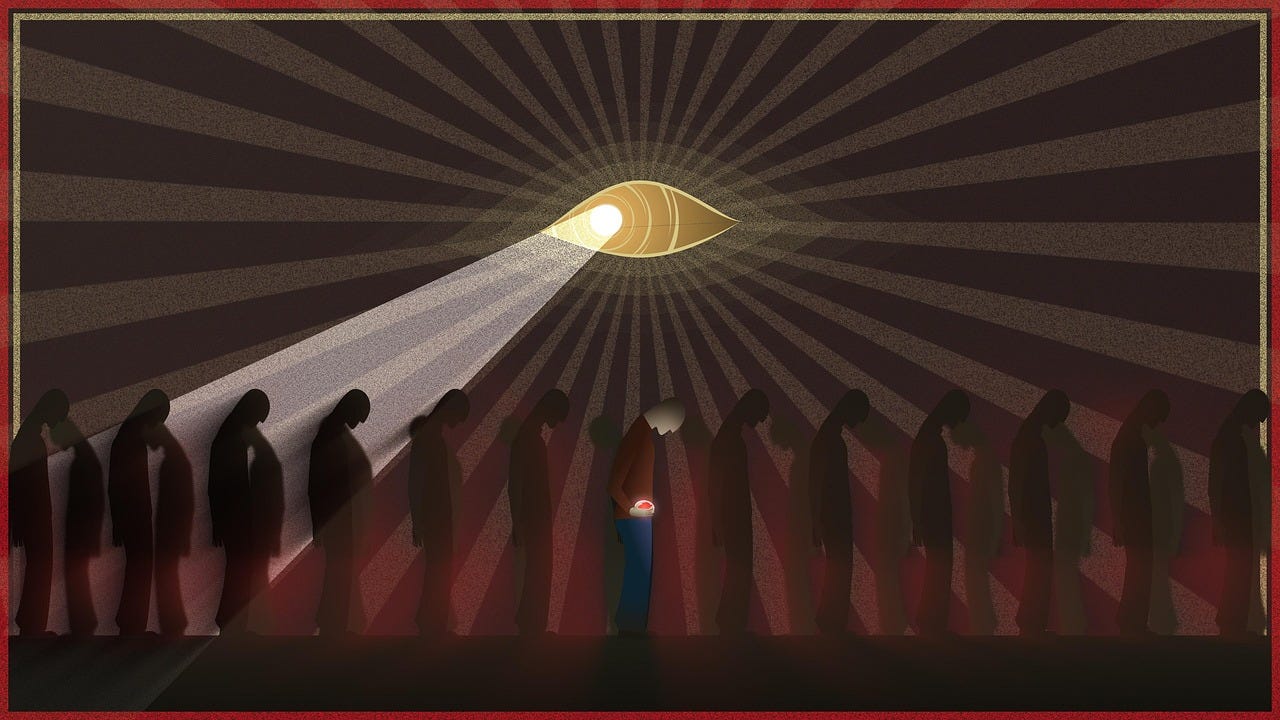
Over the last couple installments to this series on Foucault in the spatial revolution, we have traced his analysis of how – what I would call – the spatial revolution has culminated its endogenous-turn with a deeply penetrating reconceptualization of the self – body and sexuality – as Schmittian open space available to be penetrated, colonized, managed, and engineered. Managerial liberalism, as the vanguard of spatial modernity, has turned all of once temporal-oriented life – from culture, city, and family to the embodied and sexual subject – into fodder for the ambitions of experts, technocrats, and social engineers: e.g., lawyers, physicians, urban planners, therapists, pedagogists, environmentalists, social workers, hygienists, economists, epidemiologists, psychologists, and all variety of bureaucrats. As frequently alluded to in those earlier posts, for Foucault these processes are best understood as part of a larger project for the creating of a regime of biopolitics.
While I intend to finish up my discussion of those dynamics with some broader stroked observations about the post-structuralist analysis of biopolitics which Foucault was primarily responsible for birthing, there is an additional wrinkle in all of this which I think it may be productive to address as we draw to a conclusion this discussion of the spatial revolution. Insofar as both my explorations of the pluralist constitution and the spatial revolution may be quite rightly regarded as extended footnotes to my major work, A Plea for Time in the Phenotype Wars, and particularly insofar as that latter book’s core arguments are rooted in what I call “biological realism,” Foucault’s biopolitics critique conjures a philosophical cloud which — it may be suggested — hangs over my entire project.
So addressing the questions posed over the last couple posts to this series on the spatial revolution provide an opportunity to respond to such hypothesized allegation. The allegation of course would be along the lines: insofar as my epistemology and methodology appeal to scientific standards – or at least aspires to do so – isn’t my analysis of the spatial revolution in fact itself an instrument of that revolution?
From that perspective, the pretense in the recent book to “recall” the pluralist constitution may be regarded at best as confusedly self-defeating and at worst as bad faith sabotage. Invoking “science” against the spatial revolution would be like trying to save a drowning man by pushing his head underwater. Or something like that.
Parenthetically, I think it’s worth reminding everyone, particularly those who are relatively new readers here, that I have always owned up to being obviously a member of the managerial class and I have never claimed to be a temporal – not in any distinctive or exclusive sense. As I discuss in A Plea for Time, phenotypically my two highest Big Five traits are both conscientiousness and openness. Both are quite high and both are much higher than the other three traits.
So, strictly speaking, I am neither a temporal or a spatial. On the contrary, I easily see the arguments for and values of both sides in the phenotype wars. Perhaps its that phenotypic disposition which has drawn me to this work, and hopefully given me some purchase on being able to accurately capture the dynamics without being excessively crippled in such endeavors by confirmation bias or motivated reasoning. In the end, of course, that is for you, my much appreciated reader, to decide.
Insofar as I may have been perceived as privileging the recalling of the pluralist constitution, that was not based on a personal, phenotypic preference, but rather was a contingent strategy arising from the perception that all spatial revolutions eventually falter, all spatial regimes eventually collapse. There is no reason to think ours would be some world-historical exception, and some reason to think our spatial regime’s date with destiny may not be as far off as most of us would like to think.
Again, all this is discussed at great length in A Plea for Time in the Phenotype Wars. There’s no need to repeat it all here. The point was that if indeed our spatial regime is in danger of collapse within our lifetimes (maybe more yours than mine, depending on your age) than it may be wise and plausible to try and create the conditions for a softer landing when that collapse does come. It was precisely within that context than I advanced the notion that recalling the pluralist constitution could be a valuable gesture in such a direction.
In that light, I feel rather vindicated from any suggestion that I have been working here in bad faith, or misrepresenting my personal commitments. However, there is still the question raised within Foucault’s analysis of biopolitics of whether my epistemological and methodological commitments to something like the scientific tradition in fact – whether I intend it or not – does ultimately serve to subvert even that more modest and conditional aspiration to recalling the pluralist constitution.
I wouldn’t go as far as to say that such an allegation is so entirely devoid of merit as to warrant being dismissed out-of-hand. At the same time, though, I do think it is too narrow and insufficiently critical an assessment. And, fortuitously, we’ll see, this very concept under discussion over these several installments to the series on Foucault, the concept of biopolitics itself, as it turns out, provides an opportunity to propose a plausible resolution to the paradox to which some might accuse of me succumbing.
Spelling that out in detail will be the topic of the next post, which also will be both the last installment to this series on Foucault, and indeed the final substantive historical installment to our extended exploration of the spatial revolution over the last eight or so months. The first step in that direction will be to provide a concluding overview of what I’ll call the tradition of post-structuralist biopolitics, largely generated from the work of Foucault. Before that, though, it will be valuable to set the broader context by reviewing a bit of background to the central notion.
Biopolitics is a neologism dating back about a century at this point. The term was used in the 1920s by Swedish political scientist Rudolf Kjellen, University of Uppsala, (also credited by some with coining the term “geopolitics”) who used “biopolitics” to cast an organicist view of the state, in which the latter was conceived as a “life form” that preceded the individual. For the next several decades the term had a checkered career, including being used in 1934 by Hans Reiter, the head of the Third Reich’s Health Department. Reiter too used the term with an organicist flavour, describing the National Socialist’s biologically based conception of the relationship between the German people and state, with an eye to increasing the German population and improving its genetics. The term has been used at different times to also refer to a politics aimed at improving biological conditions of life, with ecological and technological concerns.
Only though over the last half of the century since Kjellen’s linguistic innovation – from the mid-1970s to the early 1980s – has biopolitics picked up steam as a marker of the intellectual foci addressed here. Interestingly though, the term gained this popularity simultaneously in divergent directions. Some have claimed these are entirely incompatible, even incommensurable directions.1 That more robust claim will be disputed in our next installment to this series on Foucault in the spatial revolution.
There’s no disputing though that each of these directions conceived their focus very differently. In fact, even within the intellectual stream flowing in each direction there have been noteworthy differences. Unearthing all such nuance though would be getting too deeply into the weeds for our purposes. For the most part these streams will be dealt with as two broad umbrella conceptions of the term. Though, in the next installment, it will be necessary to highlight an important distinction within one of those streams.
These two directions in the conceptualization of biopolitics can be broadly distinguished with the adjectives of post-structuralist and scientific. Central to appreciating the relevance of those distinguishing adjectives is to appreciate the very different role played in each by the prefix in biopolitics. For scientific biopolitics, the bio signifies a set of disciplines which are to be synthesized with the study of politics. For post-structuralist biopolitics, the bio refers to the object of action by the political practices under investigation.2
Though it may not be obvious from the preceding description, the differences here are not merely etymological, but more profoundly epistemological. The resolution of this conflict, in this series, will no doubt be entirely unsatisfactory to those who put much stock in such disputes. Hopefully it will become clear enough that there’s much more value for a renewed footing of biopolitics by soft peddling such epistemological differences than there is in fretting and wallowing over them.
Clearing up any ambiguity arising from these descriptions requires an anatomy of each of these biopolitics streams. Further, once they have each been elaborated, it will be possible to deliver the real payoff of the analysis: an unveiling of how a synergy between these two streams provides the necessary ground for analyzing biopolitics, the spatial revolution, and the phenotype wars, without necessarily becoming an inadvertent agent of the object of one’s inquiry.
Post-Structuralist Biopolitics
Foucault blazed the trail in the grounding of post-structuralist biopolitics with the first volume of his book on The History of Sexuality and in his College de France lectures in the late 70s. In this post-structuralist approach, the bio in biopolitics pointed to – not the partner in a marriage proposal, as we’ll see was the case in scientific biopolitics, but – the object of action for an emergent new form of politics. Post-structuralist biopolitics took shape in response to the observed emergence of a new version of governance, which was directed at the administration of the public as life.
The standard analysis of these developments argue that for Foucault in particular, biopolitics occasioned a shift in the legitimization of governance, from a prior model of sovereignty. This constitutes a shift in emphasis from rights to norms. In Lemke’s estimation: “The absolute right of the sovereign tends to be replaced by a logic of calculating, measuring and comparing.”3 This shift is eloquently captured in a passage from the first volume of Foucault’s History of Sexuality:
It is no longer a matter of bringing death into play in the field of sovereignty, but of distributing the living in the domain of value and utility. Such a power has to qualify, measure, appraise, and hierarchize, rather than display itself in its murderous splendor; it does not have to draw the line that separates the enemy of the sovereign from his loyal subjects. It effects distribution around the norm.
This process though should not be misunderstood as a displacement of sovereign right over death, but rather, in Lemke’s words, “the power over death is freed from all existing boundaries, since it is supposed to serve the interest of life.” What Max Weber called the state’s monopoly on violence, under post-structuralist biopolitics, simultaneously, completely colonizes the life of the citizen as a datum of the population, while being raised to ultimate moral legitimacy as the defender of life.
Returning to the last post’s use of the COVID experience as a case study, this legitimacy, backed by often at best quasi-legal police actions, was evident in the remarkably widely accepted imposition of official two-tier classes of citizens in the form of vaccine passports within self-described liberal democracies within which such official second-class citizenship would have been considered inconceivable by most people prior to the COVID pandemic. A team of German authors’ efforts4 to explicitly apply post-structuralist biopolitics to the COVID response internationally is worth quoting:
...most state responses to the SARS-CoV-2 virus have been justified in biopolitical terms by a “re-biologization” of the population, and a perceived overarching imperative to keep as many people alive as possible. Some of the most prominent means used to pursue this general end have been the familiar tools of state sovereignty: orders and decrees forbidding certain activity, requiring others, and the passing (or suspending) of laws in order to ensure that these measures are legally and constitutionally legitimate or adequately funded. Police, national guards and in some cases even the military (and paramilitary units) have been called upon to enforce restrictions. These sovereign tolls are being deployed in a broadly biopolitical sense, that is, making (rather than letting) live.
They go on to characterize the COVID response as being typically biopolitical with its focus on the rule of epidemiologists, virologists and other experts, all typical of what they cite Roberto Esposito as describing as biopolitics’ “medicalization of politics.” The union of the cult of expertise with the sovereign power of right is the hallmark of contemporary biopolitics at work, and nowhere has this tendency been more evident than in the medicalization of politics under COVID.
Over the last couple centuries, a host of knowledge generating disciplines emerged as the loci of this triumphant biopolitics, from demography to hygienics to psychology, that informed this administration of people as forms of animal life. This recognition constituted a deepening appreciation of Foucault’s well-rehearsed dictum that knowledge was power. According to Hacking, across Europe, the United Kingdom and North America, from 1820 to 1840 especially, there was an “avalanche of numbers” generated through demographic data collection, record keeping and analysis, which established the statistical instruments for administration of the public’s animal life.5 The reader is reminded of Foucault’s observation of this tendency in relation to the history of sex, discussed in the first installment to this series.
Everything from sexuality to nutrition, from disease mitigation to birth and mortality rates, became foci of leverage for managing and regulating the lives of the population. In language more colloquial than the argot of post-structuralism, this is the world of health and medical experts who set up norms of rational and moral conduct, within the home, at the workplace and in the public sphere. Jacques Donzelot, for example, in his book The Policing of Families6, demonstrates how philanthropy, social work, compulsory mass education, and psychiatry combined to exercise such biopolitics over family life, and in the process, in Donzelot’s estimation, transformed mothers into agents of the state.
Failure to conform to biopolitical norms is considered by the regime of spatial modernity as at best indicative of an abdication of legal competence and at worst an expression of anti-social behavior requiring redress for its bald threat to the common good. Again, we’ve all recently experienced such biopolitics amid the public health and mass media generated regime of existential fear cultivated by practitioners of behavioral psychology as a strategy of popular discipline and behavior modification in response to COVID.7 The governance of the pandemic was a sterling case study in how knowledge operates as power under the specific conditions of this triumphant biopolitics.
The strength of the post-structuralist insight into these developments is rooted in its rejection of any scientific discourse as inherently possessing default legitimacy.8 This attitude sharply contrasts with that cacophony of voices ringing through the pandemic echoing its knee-jerk support of the biopolitics regime with ritualized calls to “follow the science.” This warning from the post-structuralist biopolitics critique – traceable all the way back to Foucault’s original intuitions from the 70s – provides valuable intellectual resources for recognizing and possibly containing the more insidious penetration of private life by the colonization imperative of the spatial revolution in its endogenous-turn.
However, upon closer examination, post-structuralist biopolitics’ strength of insight ironically also turns out to be its lacuna of weakness. Once though that lacuna in post-structuralist biopolitics is addressed, the suggestion that the two streams of biopolitics are incompatible and incommensurable is revealed as misguided. Further, a valuable interplay, maybe we might even say synergy, between the two biopolitics streams can be identified, which not only heightens the analytic value of each, but likewise delivers my own epistemological and methodological commitments from the aforementioned allegations of paradoxical self-sabotage.
That though is the discussion for our next and final installment to this series on Foucault in the spatial revolution. And since I know you don’t want to miss that, if you haven’t yet, please…
And always feel free to recommend this Substack to any kindred spirits whom you may know…
Meanwhile: Be seeing you!
Laurette T. Liesen and Mary Barbara Walsh, “The Competing Meanings of ‘Biopolitics’ in Political Science: Biological and Postmodern Approaches to Politics,” Politics and the Life Sciences 31, no. 1–2 (Spring/Fall 2012): 2–15, https://doi.org/10.2990/31_1-2_2.
Liesen and Walsh.
Thomas Lemke, Biopolitics: An Advanced Introduction, trans. Eric Frederick Trump, 1st edition (New York: NYU Press, 2011).
Matthew G. Hannah, Jan Simon Hutta, and Christoph Schemann, “Thinking Through Covid-19 Responses with Foucault – An Initial Overview,” Antipode Online (blog), May 5, 2020, https://antipodeonline.org/2020/05/05/thinking-through-covid-19-responses-with-foucault/.
Ian Hacking, Logic of Statistical Inference (Cambridge, U.K.: Cambridge University Press, 2016).
Jacques Donzelot, The Policing of Families (New York: Random House Inc, 1980).
Laura Dodsworth, A State of Fear: How the UK Government Weaponised Fear during the Covid-19 Pandemic, 1st edition (London, UK: Pinter & Martin, 2021).
Contrary to what many advocates (and even many critics) of post-structuralism (or postmodernism) seem to appreciate, the claim that absolute, definitive truth is beyond the reach of human knowledge is not in the least incompatible with, or an epistemological death blow against science. As the greatest 20th century philosopher of science, widely credited with formally systemizing the scientific method, Karl Popper, put it: all scientific truth is contingent. No matter how convinced we are of a scientific proposition, it is only as true as it stands up to incoming evidence. Any time we relax our vigilance and comfortably assume, as some like to say, that “the science is settled,” we have abandoned science and allowed ourselves to drift into religion, or ideology, or some other discourse that resorts to belief in definitive, final truth. So, post-structuralism does indeed have more in common with science than advocates and critics alike generally acknowledge or perhaps even appreciate: Karl Popper, Conjectures and Refutations: The Growth of Scientific Knowledge, 2nd edition (London; New York: Routledge, 2002).