PREDISPOSED AND VERY CLOSE
PHENOTYPE WARS REFRESHER

I know, it seems like I keep delaying, but honestly the Canadian history stuff is coming; I’ve got a whole bunch of posts already in the can -- as the film people used to say (when they still used film). But over the holidays I felt I needed a break from my deep dive into Canadian history and so chose to reread a fine book with some significance for my phenotype wars model. I did briefly reference it in my (must read!) book, A Plea for Time in the Phenotype Wars, but didn’t give it nearly the attention it warrants. With a revised edition though having been released in 2024 (I’d read the 2013 edition), it seemed worth giving it another read, and maybe a little more love within these pages (as if we still used pages).
Partially it was a good reread just because it’s a good book, extremely relevant to my own model; it was also fun to see all the new references to Trump and Brexit and so on. Mostly though, it occurs to me that it’s been quite a while since we provided an overview refresher on the phenotype wars model on this Substack. And, as we’re about to enter a very deep dive down the rabbit hole of Canadian history -- guided by the phenotype wars model -- there may be (in fact, there are) new readers coming on board who haven’t read my (must read) book, so there would be value in providing a more detailed review of the aforementioned book. The title of which I still haven’t mentioned. So let’s get into that.
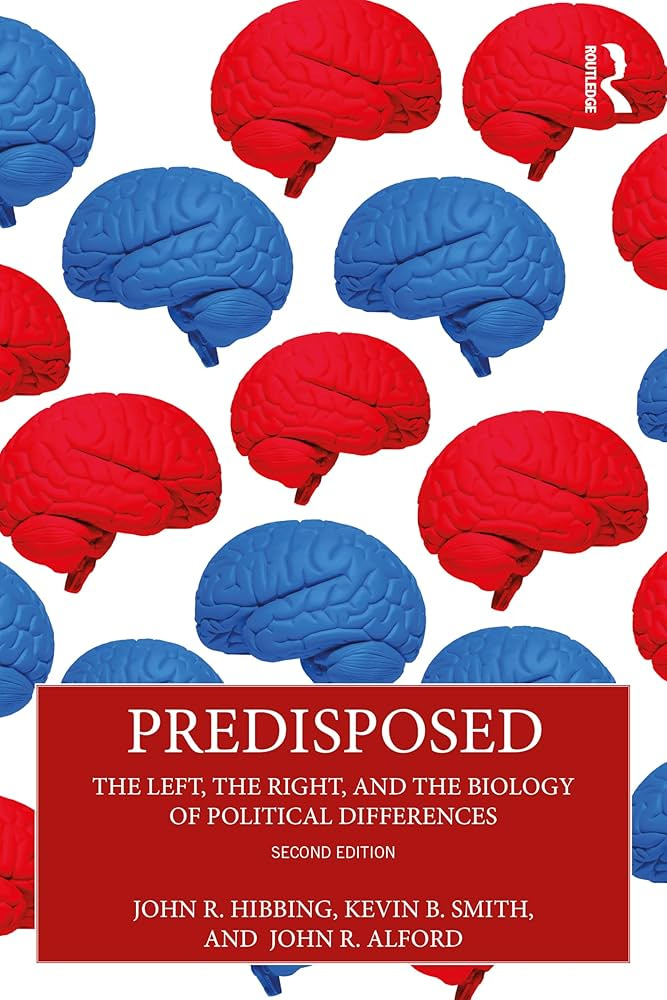
In many ways, I feel I could use the Hibbing, et al. book, Predisposed, as an introduction to my own model of the phenotype wars.1 It provides a thorough airing of most of my key points regarding the nature of the two key phenotypes, while providing insight into the core areas of empirical research that underpin such claims. I like to believe I did likewise in my (must read!) book, but in case you wanted corroboration from some other scientists, this would be a good place to look.
At the same time, though, I do believe they get a few things wrong. And it is in precisely these errors that their assumptions and analyses go astray. So it seems, considering the context sketched out above, like a valuable lesson to go through both what -- at least from the perspective of my model -- they get right and wrong. And maybe this will serve as a useful transition for the un- or less acquainted reader to better understand the claims underpinning the frequent appeals to the phenotype wars which inform the forthcoming history of the Canadian front in the phenotype wars
To be clear, their book shouldn’t be misconstrued as an alternative to mine. They do not explore how each of the phenotypes, following its own logic, inadvertently, dialectically undermines its own optimum niche, opening the door to the return to prominence, and even dominance, of the other phenotype. Nor are they attentive to how those dynamics drive history, fueling the empire and civilization cycles so widely observed in human history. All that is an important part of my book. However, as a deep dive into the empirical and experimental evidence for the existence and nature of the two key, conflicting phenotypes, Predisposed provides a depth and breadth of attention which mere space considerations prevented my doing in A Plea for Time in the Phenotype Wars.
Yet, as mentioned, I do have some objections to their work, only a couple of which I’ll expand upon here. Still, notwithstanding whatever shortcomings I find in Predisposed, it is an indispensable review of the science of the politically core phenotypes: what, for reasons explained in my own book, I prefer to call spatials and temporals.
The Opposition and Organicity of the Phenotypes
The co-authors of this book -- John Hibbing, Kevin Smith, and John Alford -- set out to establish that there are genetically different kinds of people, who manifest into specific political phenotypes: sometimes distinguished as left and right, sometimes as liberal and conservative. They acknowledge the widespread and longstanding resistance to such thinking, taking on the common retorts either that politics is a product of environmental circumstance or the result of rational thoughtfulness. The statistical correlations across a wide range of clinical findings refute the presumptions underpinning these retorts.
They take a little time to refute the appeal to rationality.
…people grossly overestimate the degree to which their actions and decisions are based on rational, conscious thought, just as they grossly overestimate the degree to which sensory input is objective.
Need examples of physiology/psychology affecting attitudes and behavior, even when people think they are being rational? Happy to oblige: Job applicant resumes reviewed on heavy clipboards (remember clipboards?) are judged more worthy than identical resumes on lighter clipboards; holding a warm or hot drink can influence whether opinions of other people are positive or negative; when people reach out to pick up an orange while smelling strawberries, they unwittingly spread their fingers less widely—as if they were picking up a strawberry rather than an orange. People sitting in a messy, smelly room tend to make harsher moral judgments than those who are in a neutral room; disgusting ambient odors also increase expressed dislike of gay men. Judges’ sentencing practices are measurably more lenient when they have just taken a rest break. Sitting on a hard, uncomfortable chair leads people to be less flexible in their issue preferences than if they are seated on a soft, comfortable chair, and people reminded of physical cleansing, perhaps by being located near a hand sanitizer, are more likely to render stern judgments than those not given such a reminder.
These examples just scratch the surface of evidence that supposedly rational judgment is vastly more reliant upon non-rational inputs than most of us would like to believe. I provide a much more extensive list of such findings and more deeply explore the dynamics and implications in my book, Biological Realism. So the attempt to refute claims of the heritability of political dispositions with appeal to human rational political thought doesn’t seem to get us very far.
They acknowledge not only that the existence of the two core political phenotypes are generated from genetically distinct material, but that such distinction has manifested across human history. And they point to a host of other traits of personality, perception, and disposition that correlate with those political phenotypes. Consider, for instance, this description of what I call temporals:
…we know that individuals concerned about defense against outsiders also are likely to be concerned about defense against in-group norm violators just as they are also likely to embrace tried and true, traditional lifestyles rather than untried and therefore risky alternatives.
The labels for particular political predispositions might be different in different places at different times, and they might be applied to wildly varying issues of the day, but a standard set of positions on bedrock dilemmas exists. We might call people Democrats and Republicans in one locale and kumquats and rutabagas in another, but in all societies there are those who favor sticking with traditional values and those who favor more experimental social arrangements, those who want to throw the book at norm violators and those who want to give them another chance, those who prefer engagement with outsiders and those who see outsiders as threats to be avoided or conquered, and those who advocate for egalitarian resource redistribution and those who resist redistribution if there is any chance it might harm insiders and help outsiders.
Ultimately, what divides Athenian and Spartan, Imperialist and Republican, Roundhead and Cavalier, Federalist and anti-Federalist, monarchist and revolutionary, Bolshevik and Menshevik, Partisan and Fascist, Alcove No. 1 and Alcove No. 2, Buckley and Vidal, Alexandria Ocasio-Cortez and Marjorie Taylor Greene, Joe Biden and Donald Trump, Jair Bolsonaro and Luiz Lula da Silva, Western democrats and Islamists seeking a new Caliphate are different perspectives on the proper way to design, structure, and maintain society. The underlying tectonic plates may go by different names, but the fault lines between them are uncannily similar.
This description is, I believe, both true and telling. Though, as we’ll see below, I’m unconvinced that the authors fully appreciate just what is the difference between these diverse manifestations of the personality/political phenotypes. Taking advantage of the updated edition they express these enduring dispositions through the lens of contemporary attitudes toward Donald Trump:
Trump detesters need to accept that Trump venerators oppose immigration, support the death penalty, oppose trans rights, and support open carry laws not because of negative experiences with immigrants or lawbreakers or members of the LGBTQ+ community, not because they fear those individuals, and not because an objective consideration of the facts suggested that those policies are best. Instead, they simply are built to prefer a society in which insiders are secure, vigilant, and not threatened by outsiders even if the threat is constituted by nothing more than the diminution in unity that the presence of outsiders brings.
Trump venerators need to accept that Trump detesters support immigration, oppose the death penalty, support trans rights, and oppose open carry laws not because they are ridiculously naïve about the dangers posed to the longstanding essence of the United States. They simply are not built to care as much as Trump venerators about the traditional insider core or their country—that is, to care about white, male, Christian, straight, conservative America. In fact, Trump detesters are more than a little bit skeptical of the value of that insider core, given that it does not seem to welcome outsiders or show much concern for the downtrodden. Providing facts about the vulnerability of traditional societal insiders as a result of population demographics and societal changes will do nothing to change their minds.
I’m quite certain that hardcore venerators and detesters each would take exception to some of the aspects of the authors’ generalized characterizations. The point though is not the precision of profile description, but the acknowledgment that there is a fundamental divide between such people at the most basic level of values and personality. Through that lens they recognize how preposterous is the popular appeal to the end of ideology.
Ideology is not…merely the ability to describe currently popular labels or to endorse clusters of positions that meet with the approval of political scientists. Ideology is us. It could no more “end” than could personality.
Their review of the experimental and clinical research findings leads them to recognize that the intellectually well-trodden political differences in these phenotypes may be merely one manifestation of a deeper set of personality differences:
Maybe “left” and “right” are just handy terms for describing people who happen to have distinct bundles of traits driving their thoughts, feelings, and actions.
…when it comes to morality and values, the left is characterized by a desire for the new and novel, a commitment to individual expression, a tolerance of difference, and an interest in stimulation; the right by a desire for order and both familial and group security, as well as a commitment to tradition and group loyalty/patriotism.
…invoking coincidence and path dependency is the hallmark of lazy theorizing…[and]...does not explain why the same political orientations align themselves with the same personal preferences, personality traits, moral foundations, and personal values in culture after culture and time period after time period.
These latter couple statements come pretty close to being at least a core pillar of Phenotype Wars 101.
Though I won’t expand much on the matter, they spend a good deal of their book unpacking the biases within standard social sciences -- and sometimes even in evolutionary psychology -- that lead so many scholars to soft-peddle or even gloss over these important phenotypic differences. Some version of a notion of human universality is usually found at the heart of such misconstruing of the human condition.
While there certainly are human universals, by no means is it credible to reduce all of human traits to some universal singularity. Findings of correlated differences in the perceptions and preferences of the two core political phenotypes point to fundamental differences in mindset that bely appeals to some universal human nature that erases claims of personality and cognitive phenotypes.
…broad swathes of the most prominent social science theories are based on the assumption that the human condition is monolithic and that any variations in human behavior are exclusively the product of the situation.
Like the gaze cuing results as well as the results on conscientiousness, openness to new experience, authoritarianism, and preference for cognitive closure, the categorization results suggest that conservatives are more likely to lock on to a task and complete it in a fashion that is both definitive and consistent with instructions. Individuals on the left are more likely to be distracted, to equivocate, and to be flexible even to the point of not performing the task exactly as the authorities intended.
…twin studies consistently report substantial heritability coefficients for personality traits as well as for political temperament. This all suggests that personality and political predispositions, while complex, do not require a precise configuration of genetic alleles, but more likely an accumulation of relatively independent, additive genetic influences.2
Differences in political temperament are tied to differences in a variety of perception and processing patterns prompted by stimuli. In other words, those on the left and those on the right, quite literally, see the world differently.
I apologize for skimming past the detailed discussions of the many areas of research that show the strong correlations with the two core political phenotypes. This post is already going to be long enough. And having the opportunity to assess that evidence is part of the appeal of this book and why, despite my efforts in A Plea for Time in the Phenotype Wars to make the best case that page space would permit, Predisposed is a valuable companion read to my book -- despite some of the important stuff I do think they get wrong (as we’ll get to shortly).
I also skim past in this discussion their several intriguing arguments for why these conflicting phenotypes have persisted in the face of evolutionary and political pressures over the years. Some of these are quite interesting and provide another good reason to give their book a read. Though, I do find one of those arguments implausible, and will address it momentarily.
At this point we can point to a few core conclusions from their book and underlying research for providing part of the empirical foundations to the broader, more ambitious arguments of the phenotype wars model. First, they argue that these phenotypes are ingrained as part of the larger gene pool. They are as historically enduring as they are politically integral. The rhetorical strategies to validate one over another always just wind up being naked manifestations of phenotypic self-interest disguised as scholarship or reason. A particularly preposterous case in point is the appeal to some kind of evolutionary superiority.
Typically, individuals on the left are eager to be told that conservatives are some type of antediluvian life form just as conservatives are equally eager to learn that people on the left somehow run contrary to the natural order. Sorry to disappoint, but this type of thinking is silly. The truth of the matter is that concepts such as “more” or “less” evolved are nonsensical. Evolution is the process of species adapting to their environments, and because the environment itself is a moving target, the process is never-ending. Evolution is not a destination but a temporary and lagging accommodation to environmental realities that existed at a certain time. If the environment shifts again, evolution will begin to move in a different direction, so no genetically based political predisposition is rightly viewed as more or less evolved.
It is interesting to me, as well, how close such an observation comes to recognizing the epigenetic and phenotypic forms of selection that drive human historical cycles. Indeed, there is the occasional observation in their book that hints at the way the conflict between the two phenotypes may drive the cycles of human history.
Left of center attitudes may thus be viewed as an evolutionary luxury afforded by life becoming less dangerous. If the environment shifted back to the threat-filled atmosphere of the Pleistocene, positive selection for conservative orientations would reappear and, with sufficient time, the resultant predispositions would become as prevalent as they were long ago.
This really does get us close to a version of Phenotype Wars 101. The last thing I want to emphasize in this -- let’s say positive -- part of the discussion is an important area which has not been sufficiently studied. This concerns the heritability of political orientation. They cite one source that rates it at 0.32. This of course is measured out of a total potential correlation of 1.0: one to one, you might say.
First off, this correlation should not be downplayed. While it is much lower than the heritability for blood type, eye color, or height, it is still over six times greater than what qualifies as statistically significant (0.05). Heritability with lower correlation than that has been found to have palpable social consequences. Yet, as the authors note, there may be something important buried in this data which biases us toward underestimating the heritability of the core political/personality phenotypes.
…measuring political beliefs inevitably involves more error than measuring height, weight, and eye color. Surveys are the key to assessing an individual’s political beliefs, and this can be a problem, given that respondents may not understand the wording of the political items on the survey, they may be distracted when answering, they may be in a contrary mood that day, or they may be reluctant to come clean about their true political sentiments.
The complications, though, go deeper than that.
…[while] we do not have the empirical data required to confirm the following assertion, we think it is highly likely that individuals with the most strongly held political orientations are also the individuals for whom genetics plays an outsized part in shaping their beliefs.
…we believe that genetics is particularly potent among the very people who are, for better or worse, the most politically influential, meaning genes play a bigger role in shaping the political dynamics of a society than implied by [general] heritability coefficients.
I would agree that it seems not merely plausible but probable that those phenotypes with most at stake in the political arena are likely to have higher tendencies for what some like to call “the hard wiring” of heritability. Indeed, the very heritability itself would provide incentive for taking a stronger, more adamant political position. So, if we could experimentally isolate spatials and temporals, heritability of political orientation might be much higher for them than the average population. Still, as the authors note, such prospects currently remain only speculative, as the experiments parsed for isolating these dimensions of the story remain undone. Twin studies in particular seem like a promising venue into studies controlling for these variables.
Broadly speaking, then, this book is a valuable companion to my own (must read!) book, A Plea for Time in the Phenotype Wars -- even if it only covers a partial set of the arguments laid out there. And, as noted above, there are some areas where I think they do go seriously astray. While I won’t review them all, the two that strike me as most important I will discuss. First, I think their use of the concept of group selection as an explanation for the perpetuation of the phenotype wars is a path bound to lead researchers astray. And second is that while their left-right definitions are better than many social scientists, they still get the categories to some degree wrong. This is most manifest in their confused approach to the phenotypic differences in attitudes to authoritarianism.
Problem one: Group selection
As mentioned, the authors make several arguments exploring how the political phenotypes can be sustainably heritable over long stretches of evolutionary time. There are some plausible cases to be made, but they start getting into trouble when they turn to a group selection argument. I have come some considerable distance in my estimation of group selection arguments. In my first book on evolutionary psychology I was pretty dismissive of the prospect, but by the time of the third book I came to appreciate there was more value here than I’d initially recognized.3
This transition in my thinking though was as a result of looking into the more sophisticated arguments. What I’d initially rejected was the idea that the group itself would replicate, almost as though it were a gene itself. And there has been a long history of evolutionary biology speaking and thinking in this way. The more sophisticated approaches, though, recognize that all evolutionary selection must pass through the keyhole of the individual zygote. So while traits which allowed a group to prosper and self-sustain, by that very success, could be replicated, the replication had to take place within the genome of its individual members and their lineages. Thinking in terms of the “good of the group” or “good of the species,” is a confused and evolutionarily unsustainable framework. The traits that sustain the group have to be good for the individual lineage, and thereby provide the means for the group to sustain and prosper based on replication of those traits.
Too often the authors of Predisposed seem to lose track of this fundamental fact of evolutionary selection. This seems most glaring when they appeal to human altruism. First of all, they seem surprisingly unaware of, let us say, the more selfish (in the Dawkins4 sense of the word) explanations of altruism -- such as were pioneered by Trivers.5 They do rightly nod to inclusive fitness as an explanation of kin cooperation and self-sacrifice, but then presume to dismiss such evolutionary mechanics in the case of human sociality -- despite the fact that the evolutionary biologist, Bill Hamilton, who provided the most vigorous explanation of such kin selection long ago explained how the very same evolutionary dynamics can apply to larger groups.6 For instance:
…the biologist E. O. Wilson, who challenged conventional arguments by asserting that individual organisms sometimes sacrifice for other organisms not only because they might be part of the same extended family and therefore share some genetic heritage (kin selection) but simply because, related or not, they are part of the same group and will benefit from that group being strong.
Some biologists acknowledge this sort of evidence and conclude that evolution might work on levels such as the group. Others remain skeptical, though without group selection it is difficult to explain the sometimes unusual levels of altruism observed in humans and many other organisms.
Parenthetically, it is interesting that, although he was well aware of -- and explicitly promoted -- Hamilton’s work, E.O. Wilson persisted in using John Maynard Smith’s phrase, “kin selection,” more than Hamilton’s term of art: inclusive fitness. Whether done so consciously or not, this usage biased the casual reader to think of the mechanisms in terms of family or kin. And it’s certainly true that Hamilton leaned heavily upon such examples in his pioneering work, explaining such phenotypic altruism, which was genetically selfish -- again, “selfish” in Dawkins’ sense.
However, Hamilton’s use of the phrase “inclusive fitness” was not semantically tied to the benefits of family or kin. It certainly had a strong manifestation in that context, but the mechanics were hardly restricted to such. The fundamental idea was that in a competitive situation it was in the interest of an organism’s selfish genes to aid, side with, and at the right proportions even sacrifice for the good of others. While this was true of kin, even in contrast to one’s wider in-group, the same mechanics applied in relation to one’s wider in-group if in confrontation with an out-group sufficiently different genetically.7
And we might add here that Phillip Rushton’s research demonstrated that humans have a powerful capacity to recognize and associate with those genetically similar -- however unconsciously.8 So the mechanisms, whatever may explain them, for Hamilton’s wider operationalization of inclusive fitness seem to be widely available.
The point here is that powerful in-group commitment and even self-sacrifice do not require some vaguely mystical notion of group replication, but rather is rooted in the fundamental biology of evolutionary selection. While there are multilevel selection pressures on fitness, all evolutionary selection again must pass through the keyhole of the individual zygote.
It’s certainly true, as the authors suggest, that their group selection notion, disarticulated from lineage evolution, would be a convenient argument for my model of the phenotype wars. It also would resonate nicely with the notions of one of my key influences, Harold Innis, who imagined a well functioning society to arise from some kind of balance between time and space biases -- as though these could be massaged into place by a project of benevolent social engineering. If the authors of Predisposed were right in their speculations on group selection, benevolent social engineering may not even be necessary! Alas, as I understand the state of the discipline, such an argument isn’t available.
This criticism of Predisposed though is only one that limits the range of evidence available to support the phenotype wars model, warning us off a theoretical dead end. It doesn’t distort understanding of that model, which my second problem with Predisposed indeed does.
Problem two: Authoritarianism
I warn in my book about the need to be cautious using the personality literature to identify correlation for political orientation. Social scientists often have definitions of left and right, for instance, which are not rooted in the historical origin of those terms (see here), but rather in definitions which are a product of the phenotype wars and the left’s current hegemony (see the book). I do think Hibbing et al, for the most part, do a good job at getting past this currency bias, though I’m not convinced they’re always as conscientious about vetting some of the studies they cite for equally valid definitions of those terms. There is one area though in which I do not think they’ve been sufficiently attentive to a correct parsing of the phenotypes. Getting this matter wrong undermines proper understanding of the phenotype wars model.
This problem lies in their general parsing of modes of governance preferred by the two phenotypes, particularly in their attribution of preferences for authoritarian rule. While the following statement strikes me as mostly correct, even here we can sniff out the beginning of the problem:
The political left [i.e., spatialism] typically is associated with support for equality and novel ways of doing things; the right [i.e., temporalism], in contrast, with support for authority, hierarchy, order, and the traditional way of doing things.
However, support for authority is not the same thing as support for authoritarian governance. We see things going astray with comments like these:
Communists, though they are traditionally placed on the left, can be a pretty authoritarian bunch, and conservatives, even though they reside on the right, are often fierce defenders of individual liberties.
Libertarians…tend to be left-leaning on social issues (gay marriage, abortion), but right leaning on economic issues (government regulations, taxes).
Here the authors are falling victim to the left/spatials rewriting of the history books (the victors always re/write the history), in which the standard left-right conflict is rhetorically repositioned as an intra-left/spatial conflict: i.e., the original right is written out of the history -- subject to conceptual extermination. But as I’ve observed elsewhere, the Girondins as much as the Montagnards sat on the left -- at least until the right had been politically eradicated. The left is pro-mass society and anti-pluralist intermediary institutions. And as I’ve also shown elsewhere, market individualism (low spatialism) and monist sovereignty (high spatialism) are not opposites, they’re symbionts. (I’ve discussed these matters at length both in A Plea for Time in the Phenotype Wars and -- my other must read book! -- Recalling the Pluralist Constitution. See also here)
It’s because they get all this confused, the authors mistakenly assign a characteristic preference for authoritarian government to the right. Even though their own reference, above, to “Communism” suggests the implicit confusion. Indeed, there are several instances in which they feel the need to explain empirical observations which contradict the authoritarian right assumption.
Ancient Kings and Queens were almost always associated with protection from outsider threats, norm violators, and dangerous societal changes—that is associated with “the right.” In the modern era, however, strong leaders might well seek to cut defense spending, facilitate immigration, promote the rights of the accused and marginalized, and to advocate for change. The result is that, depending on the positions they espouse, strong leaders could just as easily appeal to the left as to the right.
In the second half of the twentieth century and the early years of the twenty-first, it was the right in America—the Republican Party—that was more supportive of military intervention, while the long-hair, peaceniks on the left were more opposed.
Such apparent exceptions though hardly require comment if one appreciates the fallacy of attributing authoritarianism to the “right.” Certainly it has been common for scholars of the “left” to do so, but that has been a largely self-serving exercise (however consciously motivated or not) -- both facts of which are acknowledged by the authors of Predisposed. So, I find it strange then that they should see anything anomalous or otherwise in need of explanation in observing left-wing authoritarianism.
Their confusion is suggested in their pages-long analysis which uses Republican and Democrat Parties as proxies for the left/spatial and right/temporal phenotypes. Given the above acknowledged victory of the left/spatials (certainly the French Revolution had achieved victory by the end of WWI), it can hardly be surprising to observe that the Republican Party is overwhelmingly composed of leftists/spatials. Trump certainly tapped into some genuinely right/temporal (populist) sentiments, but that political project entailed a radical overthrowing of the historical Republican Party. Such an overthrow seems to me to have been a mirage, and Trump and his leadership group, once thought the saviors of the “republic” have turned out to be but another variety of defenders of the spatialist empire. But we don’t need to quibble over that.
My point is that failing to distinguish between the historical/original right and the ostensible “right” constructed by the “left” to help write the former out of the history books and the contemporary political imagination only leads to theoretical and narrative confusion. Still, even if we are careful to get these ideas straight, there’s nothing uniquely “right” (or “left”) about the appeal of authoritarian government. This is because, contrary to some of the more simplistic (even ideological) personality research agendas, deference to authoritarian governance is not a trait distinguishing left/spatials and right/temporals.
If authoritarian government ensures openness to experiments that transcend the boundaries and norms of the status quo, then left/spatials, like the Montegnards and Stalinists, will embrace it; if it enforces organic community and tradition, right/temporals, like aspiring absolute monarchists, will do so. However, the intra-phenotype source of opposition to such authoritarian governance will come from very different sources. Within the left/spatialism the opposition will come from individualist and free market libertarians, while within the right/temporalism resistance to authoritarianism will come from the pluralist and federalist defenders of traditional intermediary institutions (for understanding this, of course, my key word is Recalling the Pluralist Constitution.
To repeat, the authors of Predisposed do a reasonably good job of avoiding completely falling for the spatialist ideological framing of “left and right.” Sustainable success though in such avoidance requires intellectual vigilance -- which is aided considerably by having a sound understanding of both the theoretical and historical context of the phenotype wars.
Still, despite these blemishes, I would repeat that this book is a powerful companion to my own model, elaborated in A Plea for Time in the Phenotype Wars. It provides a level and degree of empirical and experimental support for the fundamental idea of two distinct political phenotypes which would not have been possible in my book, given its farther reaching ambition. So, hopefully that little book review will provide a valuable refresher for those already familiar with my work, and a primer (maybe encouraging an engagement with that work) on the part of newer readers of this Substack: primarily, Recalling the Pluralist Constitution and A Plea for Time in the Phenotype Wars.
And now, in the next post, without further delay, we will get started on the long journey which will be our exploration of the Canadian front in the phenotype wars. So, if you want to be first on your block see all that, and haven’t yet, please…
And if you know of someone else who you think would enjoy or otherwise profit from what we get up to hereabouts, please…
Meanwhile: be seeing you!
John R. Hibbing et al., Predisposed: The Left, the Right, and the Biology of Political Differences, 2nd Edition (New York London: Routledge, 2024).
For the un- or less-initiated, it may be worth noting here that my argument in A Plea for Time in the Phenotype Wars is not merely that personality correlates with political orientation — that is clearly true — but rather that the former is the cause of the latter: personality structure determines values, and politics are the arena in which society works out which of its members’ conflicting values will be formalized, codified, and enforced.
See, respectively: Michael McConkey, Not for the Common Good: Evolution and Human Communications (Vancouver, B.C.: Biological Realist Publications, 2016) and Michael McConkey, Biological Realism: Foundations and Applications (Vancouver, B.C.: Biological Realist Publications, 2020). In truth, I’d allowed myself to be overly influenced by some scholars -- such as Dawkins and Steven Pinker -- whom, with hindsight, I now think were straw-manning the group selection argument.
Richard Dawkins, The Selfish Gene: 30th Anniversary Edition, 3rd edition (OUP Oxford, 2006). For all the many disappointments visited upon myself by Dawkins’ (politically motivated?) utter refusal to take seriously the implications of his own work, this book remains the single greatest introduction to evolutionary biology.
Robert Trivers, “The Evolution of Reciprocal Altruism,” The Quarterly Review of Biology 46, no. 1 (1971): 35–57.
For Hamilton’s pioneering work on inclusive fitness, see: W. D. Hamilton, “The Genetical Evolution of Social Behaviour. I,” Journal of Theoretical Biology 7, no. 1 (1964): 1–16; W. D. Hamilton, “The Genetical Evolution of Social Behaviour. II,” Journal of Theoretical Biology 7, no. 1 (1964): 17–52. For his later expansion of inclusive fitness mechanics to wider group conflict in the 1970s, see: W. D. Hamilton, “Selection of Selfish and Altruistic Behavior in Some Extreme Models,” Man and Beast: Comparative Social Bahavior, 1971, 57–91; W. D. Hamilton, “Innate Social Aptitudes of Man: An Approach from Evolutionary Genetics,” Biosocial Anthropology 133 (1975): 115–32. It is of interest that many evolutionary biologists -- even those who celebrate his earlier pioneering work -- have been reluctant to acknowledge Hamilton’s expansion of the inclusive fitness logic to in-group/out-group contexts.
Incidentally, other lines of argument for how group benefiting self-sacrifice could be sustainable while maintaining fidelity with sound principles of evolutionary biology are found in the work of Dick Alexander: e.g., Richard D. Alexander, Darwinism and Human Affairs (Seattle: University of Washington Press, 1982); Richard D. Alexander, The Biology of Moral Systems (Hawthorne, N.Y: Aldine Transaction, 1987).
J. Philippe Rushton and Trudy Ann Bons, “Mate Choice and Friendship in Twins: Evidence for Genetic Similarity,” Psychological Science 16, no. 7 (2005): 555–59; J. Philippe Rushton et al., “Genetic Similarity Theory: Beyond Kin Selection,” Behavior Genetics 14, no. 3 (1984): 179–93; J. Philippe Rushton, “Genetic Similarity, Human Altruism, and Group Selection,” Behavioral and Brain Sciences 12, no. 3 (1989): 503–18.
Thank you. Looking forward to learning about Canada.